Is 432 Hz Music for Meditation Worth Hearing?
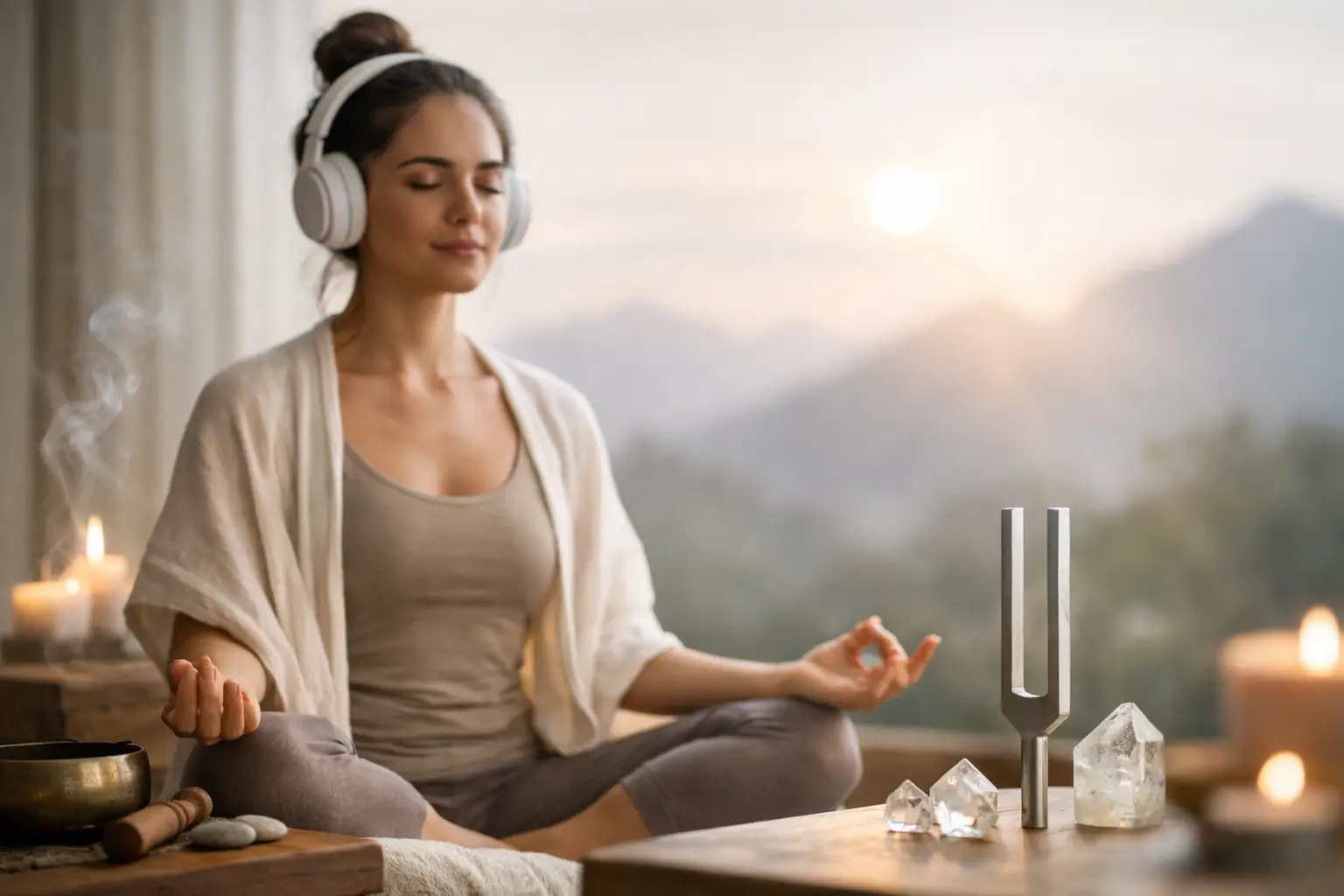
A meditation track can either make the room feel wider or make you notice every unfinished thing on your mental desk. That is why 432 hz music for meditation has caught so many ears. Some listeners describe it as warmer, softer, more natural, or easier to settle into than the standard 440 Hz tuning heard across much of modern recorded music.
That response can be real without requiring a miracle story. Music changes attention. Attention changes the body. A sustained tone, a slow pulse, a spacious arrangement, and the decision to sit still can work together in ways that are deeply personal. The useful question is not whether one number will fix your life. It is whether a piece of sound helps you return to yourself without demanding that you become somebody else first.
What 432 Hz Actually Means
When people say a track is tuned to 432 Hz, they are usually referring to the pitch of A above middle C, often called A4. In standard modern concert tuning, that A is set at 440 Hz. If A4 is set to 432 Hz instead, the rest of the tuning shifts slightly lower as well.
The difference is subtle. It is roughly 32 cents lower than 440 Hz, less than a third of a semitone. You may not identify it intellectually when a song begins. But in a side-by-side comparison, some people hear 432 tuning as a gentler placement of the same musical material. Others hear little difference. Some prefer the extra lift and brightness of 440 Hz.
Neither response makes you more evolved, more musical, or less sensitive. Ears bring history with them. The sound of a piano, the recording quality, your speakers, the key of the piece, your mood, and whether you slept well can all matter more than the tuning reference alone.
Why 432 Hz Music for Meditation Can Feel Different
Meditation does not require silence. For many people, silence is where the internal crowd gets loudest. Sound can offer a simple focal point: the slow fade of a pad, a repeating piano figure, a distant bell, the breath-like movement of a drone. It gives the mind somewhere to land when it keeps trying to sprint toward tomorrow.
Music tuned to 432 Hz may feel effective because of the tuning itself, but it may also be carrying other qualities common in meditation recordings. These pieces are often slower, less rhythmically aggressive, lower in volume, and less crowded with sharp high frequencies. They leave room. In a culture that turns everything into a notification, room is not nothing.
There is also expectation. If you press play believing a track is meant to help you calm down, you may listen differently. That does not make the effect fake. Intention is part of listening. A cup of tea does not become useless because ritual helps it feel restorative.
The most honest position is this: if 432 Hz helps you settle, use it. If it does nothing for you, there is no need to force a spiritual romance with a frequency.
The Claims Worth Questioning
The internet has attached some enormous promises to 432 Hz: cellular repair, DNA healing, cosmic alignment, guaranteed anxiety relief, and mathematical proof that it is the one true tuning of nature. Those claims can sound seductive, especially when life feels noisy and institutions have given people plenty of reasons to distrust packaged certainty.
But skepticism does not have to be cynical. There is no strong scientific consensus showing that 432 Hz tuning has unique medical or healing powers beyond other calming music. A frequency label is not a prescription, and meditation audio should not replace mental health care, medical treatment, sleep support, or help during a crisis.
There is research showing that music can influence stress, mood, pain perception, and relaxation for many listeners. That is meaningful. The leap from “music may support calm” to “this one tuning heals everything” is where the floor starts to disappear.
Be especially wary of recordings that use a 432 Hz label as a magic sticker while giving no indication of how they were created. A track can be retuned from 440 Hz, recorded directly at 432 Hz, or altered in ways that change both pitch and speed. Those are not identical experiences. None is automatically better, but the details matter when someone is selling certainty.
Make the Listening Practice Simple
You do not need incense, a perfect posture, or a retreat in the mountains to find out whether this music belongs in your routine. Give the track a fair hearing under ordinary conditions. Put your phone face down. Sit in a chair, lie on the floor, or take a slow walk somewhere you can safely pay attention.
Start with ten minutes. Keep the volume low enough that you can hear your breath and the world around you. Meditation music that blasts through your nervous system is missing the assignment, no matter how beautiful its frequency chart looks.
Instead of trying to empty your mind, notice what the music does to your attention. Does your jaw loosen? Do your shoulders drop? Do you begin chasing images, memories, or plans? Do you feel soothed, bored, irritated, or unexpectedly emotional? All of that is usable information.
If a track has vocals, decide whether words help or pull you into analysis. If it has a beat, notice whether the pulse steadies you or makes you wait for something to happen. A drone can be grounding for one person and claustrophobic for another. It depends on the listener, the day, and the design of the piece.
Try the same practice with a 440 Hz track you already love. The comparison is not a contest. It is a way to keep your ears honest. You might find that 432 Hz is your preferred doorway into stillness. You might find that the arrangement matters far more. Either result is useful.
Sound Is More Than a Wellness Product
There is a strange pressure around meditation to make every moment productive. Calm down faster. Sleep deeper. Fix your frequency. Become optimized. That mindset can turn a quiet listening session into another performance review.
Better to treat sound as art first, and support second. A recording can be beautiful, unsettling, spacious, mournful, or strange. It can carry you through grief, make room for a memory, or give you a place to stand when the news and the noise have become too much. Those outcomes do not need laboratory-perfect language to matter.
This is where independent artists have something valuable to offer. Music made outside the algorithmic conveyor belt does not always arrive pre-labeled for a demographic or engineered to hold attention every seven seconds. It can take its time. It can be quiet. It can refuse to explain itself. The World According To Gar lives in that broad territory, where reflective sound can sit beside satire, rock, photography, and social commentary without pretending that human beings only feel one thing at a time.
Choose the Track, Not the Myth
A good meditation recording should leave you with more agency, not less. If a creator insists that you need their secret frequency to be whole, step back. If a piece of music invites you to breathe, notice, rest, or simply be present for a few minutes, it has already done something worthwhile.
Listen for craft. Are the tones harsh or balanced? Is there enough movement to hold your attention without pulling you into drama? Does the recording feel alive, or is it just a frozen electronic wallpaper? A well-made ambient piece can be minimal without being empty.
The same goes for duration. Five minutes may be exactly right on a crowded weekday morning. Thirty minutes may fit an evening practice. Longer soundscapes can be useful for resting or journaling, but they are not morally superior. Your nervous system does not earn a medal for sitting through an hour of pads and rain sounds.
Let 432 Hz be an invitation, not an ideology. Put on the track, lower the volume, and give yourself ten undistracted minutes. If the sound makes a little more space inside you, stay there for a while.