Fresh Breath or Reduced Longevity? Take Your Pick.
There’s a widely repeated claim that antibacterial mouthwash “reduces nitric oxide production by 90%.” It’s worth getting the details right, because the real story is both more specific and more alarming than the headline suggests.
Where the 90% actually comes from
The number traces back to a 2013 study by Kapil and colleagues published in Free Radical Biology and Medicine. Nineteen healthy volunteers spent seven days rinsing with a chlorhexidine-based antiseptic mouthwash. Antiseptic mouthwash treatment reduced oral nitrite production by 90% and plasma nitrite levels by 25% compared to the control period.
Notice the precise wording: the 90% figure refers to oral nitrite production — the conversion happening in your mouth — not your body’s total nitric oxide output. That distinction matters, and I’ll come back to it. But the effect is real, measurable, and it showed up fast.
The pathway you didn’t know you had
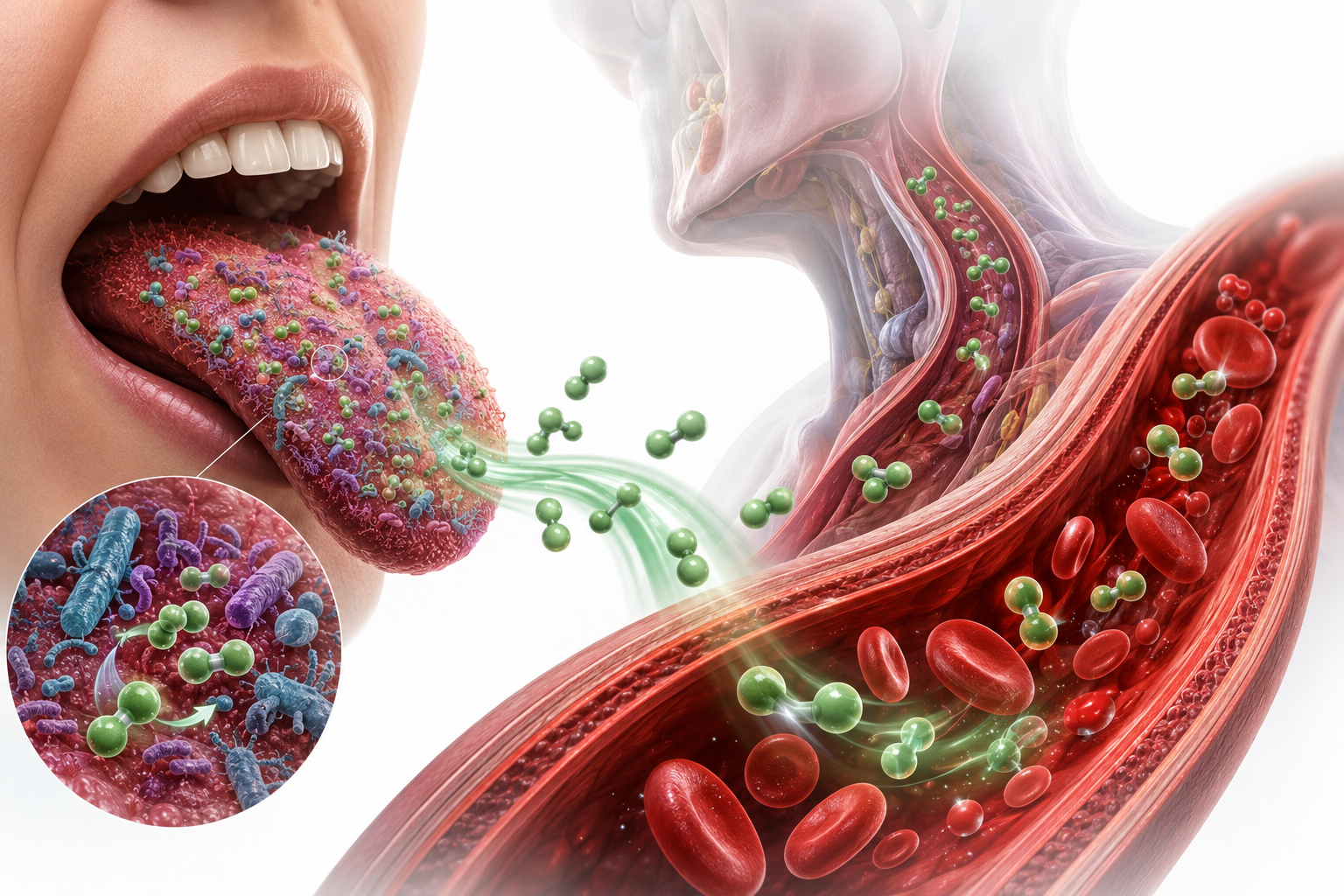
To understand why this matters, you need to know about a system called the enterosalivary nitrate–nitrite–nitric oxide pathway. It works like this: foods high in nitrates are converted and concentrated (about tenfold) to nitrite in the saliva by commensal aerobic bacteria found on the posterior dorsum of the tongue. This saliva is swallowed, and when it enters the stomach with the right pH, it is further reduced to nitric oxide and absorbed into the bloodstream via the small intestine.
The key players here are bacteria — species like Neisseria, Haemophilus, Veillonella, and Actinomyces living on the back of your tongue. Your own cells can’t perform this first conversion step. You are outsourcing a piece of your cardiovascular chemistry to microbes. When you eat spinach, beets, arugula, or celery, those bacteria are what turn dietary nitrate into the nitrite your body eventually uses to make nitric oxide.
Antibacterial mouthwash, and chlorhexidine in particular, doesn’t distinguish between “bad” bacteria and these useful ones. Because antiseptic mouthwashes eradicate the oral bacterial flora, the enterosalivary nitrate–nitrite–NO pathway is abolished, which may result in nitric oxide–deficient conditions that potentially lead to high blood pressure.
Why nitric oxide is worth protecting
Nitric oxide isn’t a minor player. Its discovery as a cardiovascular signaling molecule earned a Nobel Prize in 1998. Among its jobs: it’s involved in insulin signaling; improves sleep; lowers cholesterol; prevents high blood pressure; enhances immunity, memory, and learning; and plays a role in respiration.
The clearest, most-studied effect is on your blood vessels. Nitric oxide tells them to relax and widen. Picture two garden hoses, one narrow and one wide, with the same water pushed through each — the narrow one builds far more pressure against its walls. Your arteries behave the same way. Less nitric oxide means less dilation, which means higher pressure.
What actually happened to blood pressure
This is where the research stops being abstract. In that same Kapil study, systolic and diastolic blood pressure increased by 2 to 3.5 mm Hg, and the increases correlated to a decrease in circulating nitrite concentrations. The blood pressure effect appeared within 1 day of disruption of the oral microflora and was sustained during the 7-day mouthwash intervention.
A separate trial in treated hypertensive patients found a similar direction of effect: use of antibacterial mouthwash over 3 days resulted in higher systolic blood pressure of 2.3 mm Hg relative to control.
A 2–3.5 mm Hg rise might sound trivial. At the individual level, on a given afternoon, it mostly is. But blood pressure is a population-level risk factor, and small shifts sustained across millions of people translate into meaningfully more strokes and heart attacks. And this was showing up in healthy volunteers after a single week.
It may not stop at blood pressure
The concern extends beyond hypertension. Researchers studying the San Juan Overweight Adults Longitudinal Study found that people using mouthwash twice daily or more at baseline had an approximately 50% increased risk of developing prediabetes/diabetes combined, compared to those who used it less than twice daily or not at all. The same research group later reported an association between frequent mouthwash use and hypertension risk over time. These are observational findings — correlation, not proof of cause — but they line up uncomfortably well with the mechanism.
Putting the numbers in perspective
It’s tempting to file the “90%” under exaggeration, because it describes only your mouth. But do the arithmetic before you relax. The enterosalivary pathway supplies up to about 25% of your circulating nitrite, and daily antiseptic rinsing knocks that pathway down by roughly 90%. Multiply those together — 0.25 × 0.90 — and you’d predict a drop of just over 20% in total circulating nitrite. That is almost exactly what Kapil’s volunteers showed: plasma nitrite fell 25%.
So the honest headline number isn’t 90% and it isn’t trivial. It’s a roughly one-quarter reduction in the nitrite your body carries in circulation, appearing within a single day, sustained for as long as the rinsing continues. A drop that size is not a rounding error. It’s a substantial, systemic shift in the chemistry that keeps your blood vessels relaxed — and it’s happening in healthy people doing nothing more than following the “twice daily for freshness” instruction on the bottle.
Two genuine qualifications remain, and they cut both ways. First, this is circulating nitrite — a precursor and reservoir for nitric oxide — not total NO synthesis. The enzyme eNOS keeps producing nitric oxide on its own, and is believed to account for around 70% of serum nitrite, which is why the total drop is a quarter rather than the full 90%. But a quarter of your reservoir is still a quarter of your reservoir, and the measured blood pressure rise confirms the body notices. Second, the effect varies between individuals depending on enzyme activity, and the trials are small and short — Kapil’s had 19 people. This is mechanistically coherent, consistent evidence, not a courtroom verdict. The direction, however, is not in doubt.
So what do you do with this?
None of this means oral hygiene is bad for you. Gum disease and its bacteria carry their own well-documented cardiovascular risks, and there are real medical reasons a dentist might prescribe chlorhexidine for a defined period. The target here is narrow: the habit of reflexively swishing broad-spectrum antibacterial rinse twice a day, indefinitely, for “freshness.”
A few reasonable takeaways:
- Daily antiseptic mouthwash is probably not something a healthy person needs as routine maintenance, and there’s a plausible cardiovascular cost to it.
- Mechanical cleaning — brushing and flossing — removes plaque without carpet-bombing your entire oral microbiome.
- If you’re eating nitrate-rich vegetables specifically for their cardiovascular benefits, rinsing with antibacterial mouthwash afterward may cancel much of that benefit, since the bacteria doing the conversion are exactly what the rinse kills.
- If a clinician has prescribed chlorhexidine for a specific problem, follow that guidance — this is about unnecessary daily use, not medically indicated treatment.
The larger lesson is a humbling one. We spent a long time treating bacteria as things to be eliminated. It turns out at least some of the microbes in your mouth are quietly running a chemistry set your heart depends on. Sometimes the healthiest thing is to leave the ecosystem alone.
This article is for general information and isn’t medical advice. If you have high blood pressure or specific oral health concerns, talk with your doctor or dentist before changing anything.
References
- Kapil V, Haydar SMA, Pearl V, Lundberg JO, Weitzberg E, Ahluwalia A. “Physiological role for nitrate-reducing oral bacteria in blood pressure control.” Free Radical Biology & Medicine. 2013;55:93–100. PubMed
- Bondonno CP, Liu AH, Croft KD, et al. “Antibacterial mouthwash blunts oral nitrate reduction and increases blood pressure in treated hypertensive men and women.” American Journal of Hypertension. 2015;28(5):572–575. PubMed
- Joshipura KJ, Muñoz-Torres FJ, Fernández-Santiago J, Patel RP, Lopez-Candales A. “Over-the-counter mouthwash use, nitric oxide and hypertension risk.” Blood Pressure. 2020;29(2):103–112. Taylor & Francis
- Senkus KE, Crowe-White KM (review context); see “Pathways Linking Oral Bacteria, Nitric Oxide Metabolism, and Health.” PMC. PMC9124908
- Blot S. “Antiseptic mouthwash, the nitrate–nitrite–nitric oxide pathway, and hospital mortality: a hypothesis generating review.” Intensive Care Medicine. 2021;47:28–38. PMC7567004
- Toonen E, et al. “The Effect of Chlorhexidine Mouthwash on Blood Pressure: A Systematic Review and Meta-Analysis.” International Journal of Dental Hygiene. 2026. Wiley Online Library